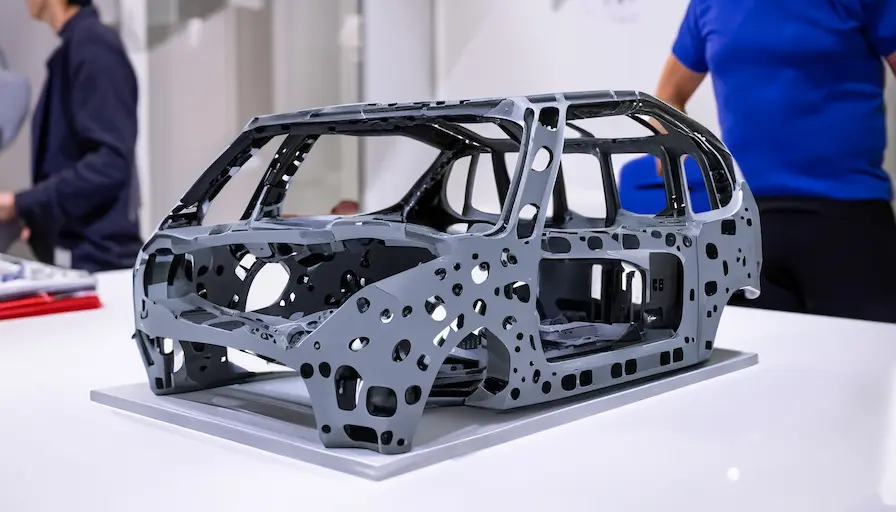
The automotive industry is on the brink of a manufacturing revolution with the emergence of 3D printing technology. This groundbreaking process, also known as additive manufacturing, has opened up a world of possibilities for designing and producing automotive components. In this blog, we will explore the various applications of 3D printing in the automotive sector, delve into its pros and cons, and examine the engineering properties that drive this transformative technology. Let's embark on a journey through the intersection of automotive engineering and 3D printing.
Applications of 3D Printing in the Automotive Industry
The adoption of 3D printing in the automotive sector has rapidly gained momentum, and it's no surprise considering the wide range of applications it offers. From rapid prototyping and concept development to creating intricate, custom parts, 3D printing has proven to be a game-changer. Additionally, it enables the production of lightweight yet sturdy components, enhancing fuel efficiency and overall vehicle performance. The automotive industry has embraced 3D printing for creating engine components, interior elements, customized exterior parts, and even entire vehicle prototypes.
Pros of 3D Printing in Automotive Manufacturing
- Design Flexibility: 3D printing allows automotive engineers to bring their most complex and innovative designs to life without the constraints of traditional manufacturing methods.
- Rapid Prototyping: Iterative design cycles are significantly accelerated with 3D printing, reducing development time and costs for new vehicle models.
- Weight Reduction: By utilizing lightweight materials and intricate lattice structures, 3D printing facilitates the production of parts with reduced weight, contributing to fuel efficiency and lower emissions.
- On-Demand Production: 3D printing enables just-in-time production, reducing inventory costs and waste.
Cons of 3D Printing in Automotive Manufacturing
- Material Limitations: Although the range of 3D printable materials is expanding, some materials may not yet meet the strict requirements of certain automotive applications.
- Post-Processing Requirements: Depending on the printing method and material used, post-processing steps such as surface finishing and inspection may be necessary, adding to production time and costs.
- Production Speed: While 3D printing offers rapid prototyping benefits, mass production of certain automotive parts may still be slower compared to traditional manufacturing processes.
Engineering Properties Driving 3D Printing Advancements
Several engineering properties play a critical role in the successful implementation of 3D printing in automotive manufacturing:
- Material Strength: High-strength materials are essential for producing durable and reliable automotive components, ensuring safety and performance.
- Heat Resistance: Automotive parts often face elevated temperatures during operation, making heat-resistant materials crucial for long-term functionality.
- Dimensional Accuracy: Precise dimensional accuracy is essential to ensure that 3D-printed parts fit perfectly into complex assemblies.
- Surface Finish: Improving surface finish is vital for reducing friction and optimizing aerodynamics.
Conclusion
The integration of 3D printing in the automotive industry is reshaping the way vehicles are designed, produced, and customized. Its diverse applications, design flexibility, and potential for lightweighting are driving innovation and efficiency in automotive manufacturing. While 3D printing continues to evolve, the industry is eagerly embracing this technology to address complex engineering challenges and bring cutting-edge vehicles to the road.
Tags
Content Summary
This blog explored the significant impact of 3D printing on the automotive industry. From its versatile applications to the advantages and challenges, 3D printing is revolutionizing automotive manufacturing. The crucial engineering properties driving this technology were also highlighted, underscoring the importance of material strength, heat resistance, dimensional accuracy, and surface finish. As 3D printing continues to advance, automotive engineering is set to enter a new era of innovation and sustainable production.